Built for higher education. Proven for community colleges.
Kenii is built in North Carolina by a focused team for one institution type: the community and technical college asked to modernize on a legacy budget. We built the platform alongside an active community college from the start, so the features you evaluate are running in production rather than waiting in a roadmap.
We are not the biggest catalog vendor in higher education.
We are the one that still answers the phone.
Eighteen colleges. The same three problems.
We have worked with more than eighteen community and technical colleges, and the story barely changes. A catalog that is out of date the week it publishes, a curriculum process living in email, and a renewal that climbs every year. Kenii was built to answer those three.
See what we built
Running in production, not in a roadmap.
Kenii Catalog has been live on a community college’s own domain since before we called it finished. Everything you can evaluate is software a college uses on an ordinary Tuesday, rather than a prototype staged for an evaluation and quietly reset afterwards.
Read the customer story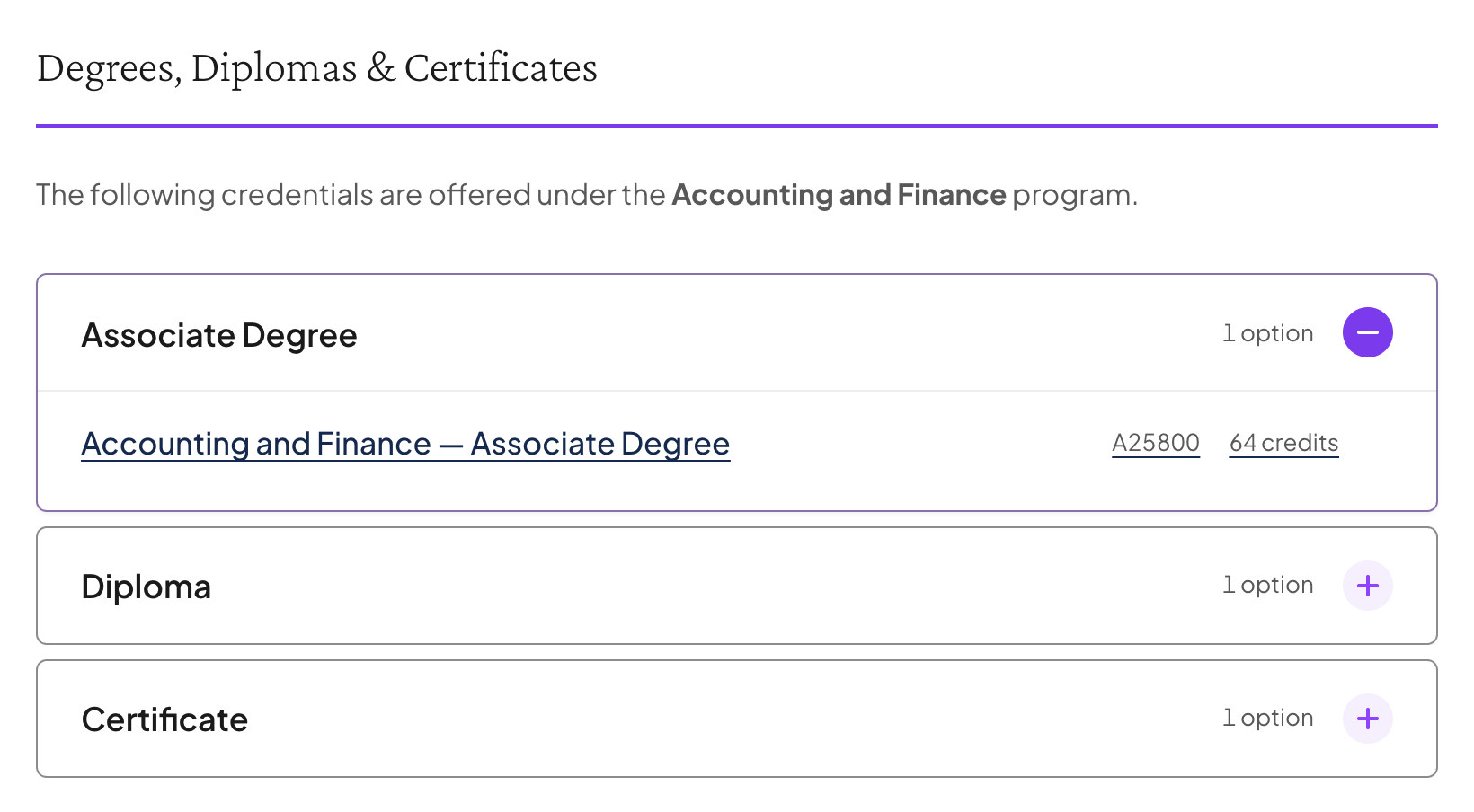
We stayed close to the requirements.
Dual enrollment, state transfer articulation, and the terminology each state uses are core requirements rather than edge cases. We learned them from inside one system, then made the labels configurable so a college in any state sees its own vocabulary.
Explore transfer articulation
What sets Kenii aside is that it is all built into one, and it is inside your own website. It has surpassed anything we could have ever imagined.Jason Freeman Chief Information Officer Martin Community College
A clear path from first call to live catalog.
What happens between deciding to look at Kenii and publishing your catalog on your own domain. The depth of the middle steps depends on the setup scope you choose.
Discovery call
We look at your current catalog, how it is maintained today, and what migrating it would actually involve, before anyone commits to anything.
Data migration
Your programs, courses, credentials, and policies move into Kenii’s connected schema. How much of that we handle is set by your implementation scope.
Staff training
Training built for catalog coordinators rather than developers, aimed at the people who will actually maintain the catalog after launch.
Platform launch
Your catalog goes live on your own college website, in your own brand colors, indexed on your own domain rather than a vendor subdomain.
Ongoing support
You keep a direct line to someone on the product team who knows how your catalog is set up, rather than starting again with a queue each time.
Your catalog stays yours, whatever happens to us.
Housed in your own database
Kenii runs inside your institution’s WordPress environment and writes to your database. There is no vendor server sitting between you and your academic records.
Open formats, exported anytime
Pull a complete catalog snapshot in structured JSON or CSV whenever you want one, through the REST API or the admin, without asking us first.
A lapsed license is not destructive
If a license lapses, everything keeps working for 60 days. After that every public catalog page stays live and read-only, so your site never breaks, and the admin becomes export-only. Your records stay intact, ready to renew or export. We will not hold your catalog hostage.
A direct line to the people who build it.
Support without a ticket queue
When you get in touch you reach someone who knows how your catalog is put together, rather than a first-line agent working from a script.
A roadmap shaped by users
Requests from working catalog coordinators and CIOs reach the people writing the code, which is why the product looks like the job rather than the category.
One team, start to finish
Implementation, training, and support come from the team that builds the software. There is no agency handoff and no third party learning your catalog on your time.
Built for community colleges
We work on the enrollment, governance, and budget realities of community and technical colleges rather than adapting a tool built for a research university.
Questions institutions ask about Kenii.
- Is Kenii too small a company to bet an accreditation-facing system on?
- It is a fair question to ask any vendor. Two things make it a smaller risk here than it looks. Implementation and support come from the people who wrote the platform rather than from a layer in between, and Kenii runs on your own WordPress site and database, so our company is not a single point of failure for your catalog.
- Why build a platform specifically for community and technical colleges?
- Community colleges carry the enrollment pressure and compliance requirements of a university on a fraction of the budget and staff. We built for that gap rather than adapting a generic enterprise system down to fit it.
- Why North Carolina?
- It is where we are based and where the first college ran Kenii in production while we were building it. Dual enrollment and state transfer requirements shaped the data model early, and the state-specific terminology is configurable, so a college anywhere sees its own vocabulary rather than ours.
- What if Kenii is acquired or the company changes hands?
- Your catalog lives in your institution’s own database on your own infrastructure, and exports in open formats on demand. A change on our side does not move your data or your ability to get at it.
- How is support different from a legacy vendor?
- You get direct contact with the people building the software rather than an anonymous queue, and implementation and training are delivered by that same team rather than subcontracted out.
Talk to the team that actually builds it.
Request a branded demo and we will stand up a live Kenii site carrying your college logo and colors, pre-loaded with demo catalog content, then follow it with a written quote your purchasing office can work from.